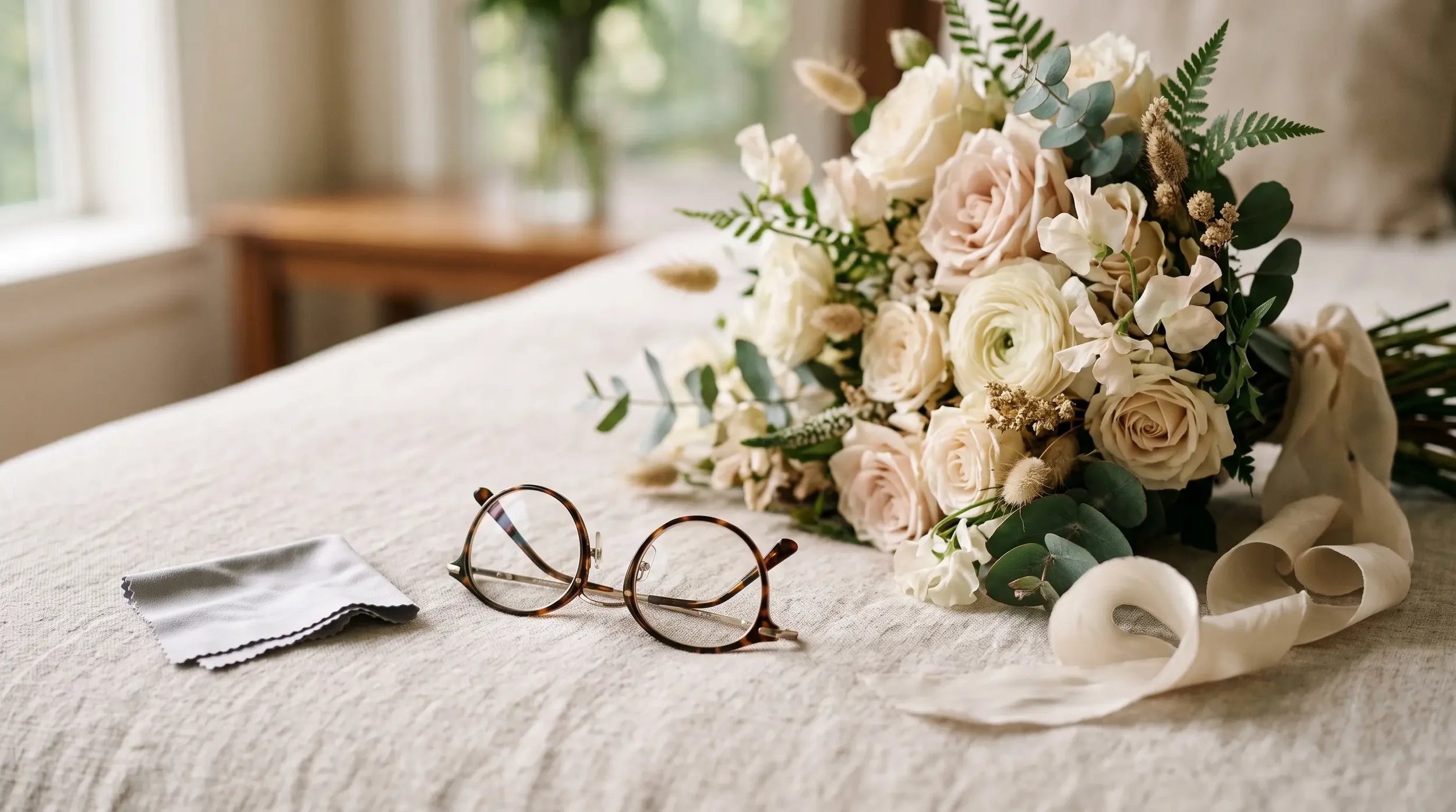
You wear glasses every day — and now, planning your wedding, you're wondering whether they belong in the photos you'll keep forever. Here's the reassurance: brides with glasses (and grooms too) look completely at home on the big day, and plenty of couples keep them on from the first look to the last dance.
The trick is getting them to their best before the day — an up-to-date prescription, clean lenses that don't throw glare in every flash, and frames you actually love looking at. If your prescription recently changed, the simplest move is often to re-lens the frames you already own rather than buy a whole new pair. Here's how to get your glasses wedding-ready.
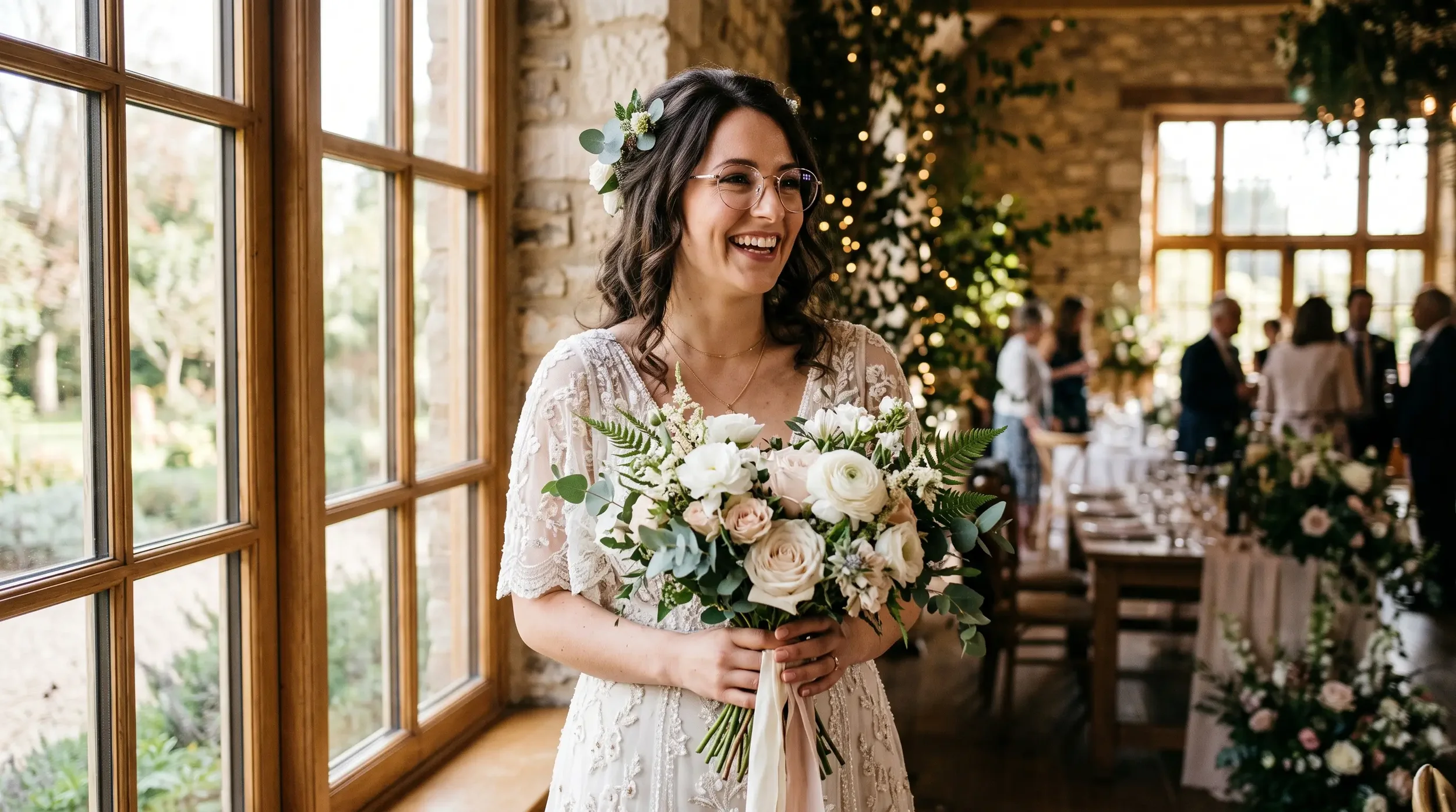
Yes, Brides (and Grooms) With Glasses Belong on the Big Day
There's nothing to "fix" about wearing glasses down the aisle. They're part of how you look every day, and keeping them on makes your photos honestly you. The couples who second-guess it usually aren't worried about the glasses themselves — they're worried about two things: glare in the photos and an out-of-date prescription. Both are easy to handle before the day.
The glare fix is a coating. Ask your optician for anti-reflective (AR) coating on your lenses; it cuts the reflections a camera flash or bright venue lighting would otherwise bounce straight back off the lens. It's the single biggest difference between glasses that settle into a beautiful portrait and glasses that show up as two bright circles.
The prescription fix is timing. If your script has changed, update it well before the wedding so your eyes look natural through the lens and you're not squinting through the ceremony. Often that just means new lenses — not a new pair.
Re-Lens or Buy New? Getting Your Glasses Wedding-Ready
If you love your frames and they're in good shape, re-lensing them with your current prescription is the fast, affordable path to wedding-ready glasses. Online eyewear services like Overnight Glasses let you send in the frames you already own and get updated lenses back without buying an entirely new pair. Whether that works comes down to a few things a lab checks before cutting anything: frame material, condition, lens shape, and how much your prescription changed. A frame that passes inspection can often be re-lensed quickly and affordably; one that fails could damage new lenses during fitting or leave you with poor optical centering.
What Makes a Frame Worth Re-Lensing
The first thing any lab evaluates is whether a frame is physically sound. Scratches on the lens don't matter at this stage — those are being replaced anyway — but the frame itself has to hold its shape. Warped temples, cracked hinges, stretched nose pads, a bent front frame: all of these create real headaches. When a frame can't hold lenses securely in position, your optical center won't align with your pupils, and that misalignment causes eye strain and blurred vision even with a perfectly accurate prescription. Plastic frames tend to develop stress fractures near the lens grooves with age, and a technician will spot these immediately; metal frames sometimes have loose screws or worn barrel hinges that can't be tightened reliably. The fix is sometimes minor — a screw or a hinge adjustment — but if the frame is structurally compromised, new lenses won't rescue it. Have a technician assess your frames before you commit.
How Much Your Prescription Changed
A modest prescription change — say a quarter or half diopter shift — rarely causes issues with an existing frame. But a major change, especially one involving new astigmatism correction or a significant jump in sphere power, puts very different demands on the lens. Thicker lenses don't always fit cleanly inside frames built around thinner ones, and high-index lenses (thinner and lighter than standard plastic) need specific frame geometries to avoid distortion near the edges. If your prescription has shifted considerably, the lab will check whether the frame's lens opening — the "eye size" — is compatible with the minimum blank size needed to cut your new lenses. It's not a common problem with mild changes, but ask the optician upfront whether your prescription jump could affect lens blank compatibility.
Re-Lens or New Pair? A Quick Guide
| Re-lens your current frames when… | Buy a new pair for the day when… |
|---|---|
| The frame is structurally sound — no warped temples, cracks, or stretched nose pads | The frame is broken, bent at the bridge, or has worn-out nose pads |
| Your prescription changed only modestly (about a ¼ to ½ diopter) | Your prescription jumped a lot — new astigmatism or a big sphere change that strains the lens fit |
| The frame already fits well and sits correctly on your face | The frame never fit right — it slides, tilts, or sits too low |
| The frame has enough height for your lens type | You need progressives and the frame is too short for the corridor |
| The frame material is intact | The frame was damaged by heat, chemicals, or a hard impact |
| Your lenses use a standard, compatible base curve | You need specialty lenses (polarized, photochromic, blue-light) that need a different base curve or geometry |
When to Buy a New Pair for the Day Instead
Re-lensing is the right move for a lot of couples, but not every time. A few situations call for a fresh pair.
Damaged or Ill-Fitting Frames
Broken frames, bent bridges, or worn nose pads don't become functional again just because the lenses are new — and fit matters more than most people realize. If your frames were never quite right, new lenses inside them won't fix the fact that they sit too low or crowd your lashes. Optical centering depends on consistent positioning on your face; a frame that slides or tilts even slightly undermines the prescription. If you've been compensating — tilting your head, constantly pushing the glasses back up — those habits are masking a problem fresh lenses won't solve. Frames damaged by heat, chemical exposure, or a hard impact should also be retired, because the material integrity isn't guaranteed and a freshly cut lens could pop out unexpectedly. Buying a new pair in these cases protects your investment in the lenses themselves — and you don't want a wardrobe malfunction mid-ceremony.
Progressive and Specialty Lenses
Progressive lenses — no-line bifocals — require specific measurements that depend partly on frame height. The corridor length (the vertical distance over which power transitions from distance to near) needs a minimum frame height to work; short, low-profile, or sporty frames often can't accommodate a standard progressive, leaving a near zone too narrow to read comfortably. Specialty lenses — blue-light filtering, photochromic, or polarized — have thickness and curvature profiles that need to match the frame's base curve, and a frame built for one base curve can't always hold a different one without warping or distortion. These aren't dealbreakers every time, but some frame-and-lens combinations simply don't work together, no matter how good the frame looks.
How Re-Lensing Works — and When to Start
Sending frames out for re-lensing is more straightforward than most people expect: clean them, pack them securely, and ship. The lab runs a physical inspection before cutting anything — measuring eye size, bridge width, and temple length to confirm the lens blank you need is available, and checking hinge tightness, groove integrity, and material stability. A reputable lab contacts you before proceeding if something disqualifies the frame. Once everything checks out, a lensometer confirms your current prescription as a baseline, the new lenses are cut to your frame's exact measurements, and fitting involves warming the frame slightly so it accepts the lenses without cracking.
The whole process typically takes one to several business days, plus shipping both ways. That's the part couples underestimate: start at least a few weeks out, not in the final week before the wedding. Give yourself room for the round trip and a buffer in case the lab flags something.
Glasses in Your Wedding Photos: A Few Quick Tips
Get anti-reflective coating. It's the number-one fix for glare and does the most to keep your lenses from catching the flash.
Tell your photographer you wear glasses. A good one will adjust their lighting angle — and may have you tip the frames a hair — to keep reflections out of the frame.
Bring a lens cloth. Smudges disappear in person but show up in close-ups. A quick wipe before the first look and the portraits is worth it.
Keep a backup. A spare pair or a hard case on hand saves the day if something bends or drops during the getting-ready chaos.
Glasses, contacts, or both is your call. Some brides wear glasses for the ceremony and switch to contacts for dancing; plenty keep the glasses on all night. There's no wrong answer — just decide ahead of time so you're not choosing at the altar.
Frequently Asked Questions
Can a bride wear glasses on her wedding day?
Absolutely. Brides with glasses look every bit as elegant — the keys are anti-reflective lenses so there's no glare in the photos and a current prescription so your eyes look natural. Wear them with confidence, or switch to contacts for the reception if you prefer; there's no wrong choice.
How do you avoid glare on glasses in wedding photos?
Anti-reflective coating does most of the work. Beyond that, tell your photographer you wear glasses so they can adjust their lighting angle, and keep the lenses clean — smudges show up in close-ups.
Should I get contacts for my wedding instead?
Only if you want to. Glasses photograph beautifully with the right coating, and plenty of couples keep them on all day. Some do glasses for the ceremony and contacts for dancing — it's entirely personal.
How far ahead should I update my glasses before the wedding?
At least a few weeks. Re-lensing takes one to several business days at the lab plus shipping both ways, so don't leave it to the final week — and build in a buffer in case the lab flags something.
The Bottom Line
You can absolutely wear glasses on your wedding day, and doing it well comes down to a little planning: solid frames, a current prescription, anti-reflective lenses, and enough lead time to get them ready. If your frames are in good shape and your prescription change is reasonable, re-lensing keeps a pair you already love on your face — and saves the cost of a whole new one.
We're behind the scenes at weddings most weekends, and here's the pattern: the couples in glasses who look sharpest in their photos aren't the ones who took them off — they're the ones whose lenses don't throw glare and whose prescription was current. Glasses have never made a wedding photo worse; a flash bouncing off an un-coated lens has. Sort those two things early, and your glasses will look every bit as much a part of the day as everything else you planned.